

We wrote about the concept of “omnichannel intelligence” 6 months ago, where firms would combine human intelligence with artificial intelligence (AI) to create the optimal output. Since then, we have seen the market adopt this approach, with many professionals utilizing AI to improve their work quality and efficiency. The market adopting this hybrid approach is also good news for job seekers, since AI has yet to replace humans in most industries. However, things are changing quickly, and it strikes us that it’s critically important to think about these issues, especially given that private real estate is typically on a five-year investment cycle.
Framework for Real Estate
Our general framework for investing in real estate through the age of AI is to focus on the following: 1) apartments with exposure to diverse employment bases (emphasis on healthcare), 2) infill industrial with last-mile exposure, and 3) grocery-anchored or necessity-based shopping centers. Given the uncertainty around the impact of AI on the economy, we think that these areas are likely to remain more resilient and defensible than other areas. We also think that they should hold up over a five-year investment period and retain their terminal values.
Back to Fundamentals
Given the above, how are traditional real estate fundamentals lining up for apartments, infill industrial, and shopping centers?
Apartments
Like all real estate, for apartments it is all about supply and demand. Too much supply relative to demand results in low occupancy, concessions, and lack of rent growth. Too little supply results in the opposite. Typically, the market is somewhere in between, with a healthy balance of supply and demand. However, in 2022-2024 the U.S. apartment market got overbuilt as a result of an overheated market induced by post-COVID interest rates and economic stimulus. In mid-2026, we are finally at the point where supply and demand are coming back into balance. We call this the “inflection point” for supply and demand.
Recent data has skewed more positive, with U.S. multifamily net absorption strongly outpacing completions in Q2 2026, per a recent report from CBRE. Rent growth measured year-over-year has turned very slightly positive this summer, though it is market dependent. Struggling markets like Austin and Denver, while still negative, have improved over recent months and become less negative. Apartments.com recently revised its rent growth metrics higher for U.S. apartments for the second half of this year, based on strong absorption in the first half of this year. We would note that a good time to get involved in a sector is one when fundamentals are on the verge of improving or accelerating. This is a time when the change is typically not yet priced in by the market.
Industrial
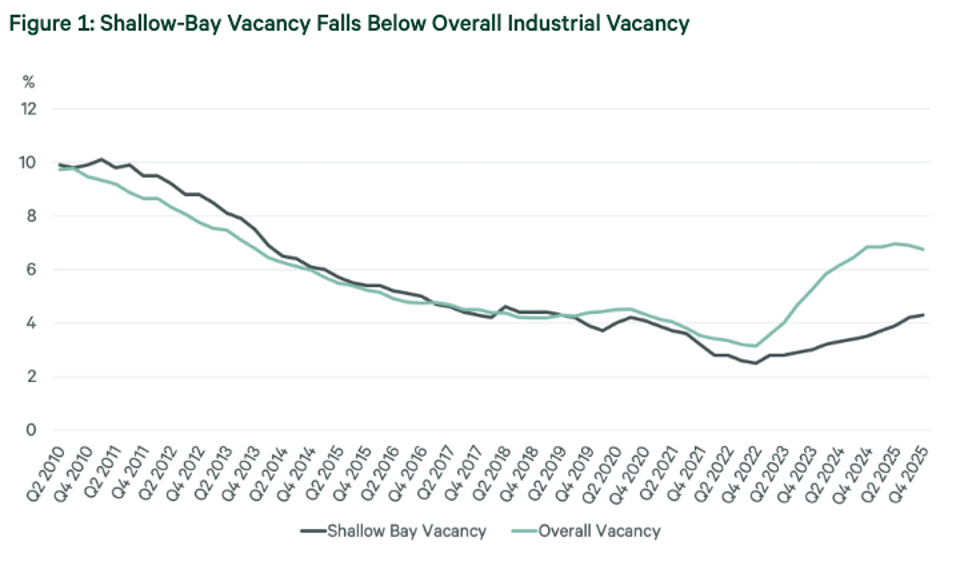
Infill industrial buildings are located near city centers and are typically older and smaller, but still very functional for a variety of manufacturing and distribution tenants. There is plenty of demand for this type of space, as evidenced by the 4% vacancy rate per the below chart from CBRE, which is lower than the vacancy rate for overall industrial. Beyond strong demand, we like infill industrial for a few reasons: first, these types of buildings can be acquired cheaply at a low basis. This entry price, along with the fact that there is typically limited space around to build, protects against the threat of new supply. Second, they have low rents that are affordable and competitive. Raising rents from $6.00 PSF to $7.50 PSF doesn’t impact the tenant’s profitability all that much, while it is a significant increase to building cash flow. Finally, longer-term, we think that infill industrial will continue to be important. While self-driving trucks and humanoid robots or drone deliveries may impact the supply chain in the future, we think that there will still be a need for last-mile manufacturing and distribution near population centers.
Retail
After more than 10 years of being out of favor, since e-commerce and Amazon started taking share from traditional retail in the mid-2010s, retail is back! Given the weak fundamentals over the last decade, there has been very limited development and new supply added to existing inventory. The overall retail vacancy rate in the U.S. is just under 5%, per CBRE, the lowest level in 20 years. Retailers have figured out omnichannel retail, or combining e-commerce with brick-and-mortar stores to both optimize the experience for customers and minimize costs to the retailer. While e-commerce is still growing faster than overall retail sales, the relative growth rates have converged and the percent share sits around 17% right now. Moreover, click and collect sales (aka buy online, pick up in store) are growing at a faster overall pace than e-commerce overall. Importantly, click and collect involves a physical brick-and-mortar store, which is further increasing demand for physical space as a means to efficiently distribute goods. In short, fundamentals are lining up nicely for retail on the demand side. While we haven’t seen significant rent growth yet, sitting around 2-3% currently, we think that it is likely to improve from here. Cap rates have started to come down from the sector, from fairly elevated levels, but likely have more room to compress, particularly if rent growth accelerates further.
Interest Rates
One tricky part of real estate is that it is inextricably tied to the macro economy and specifically, interest rates. Interest rates impact real estate in two ways: 1) they are an input to cap rates and 2) interest rates determine the rates on debt used to finance real estate. Higher interest rates increase the required return for real estate, thus increasing cap rates and bringing down prices. Additionally, higher interest rates on debt results in more cash flow going to service debt, lower debt amounts, and lower levered returns. This in turn impacts the price and cap rates.
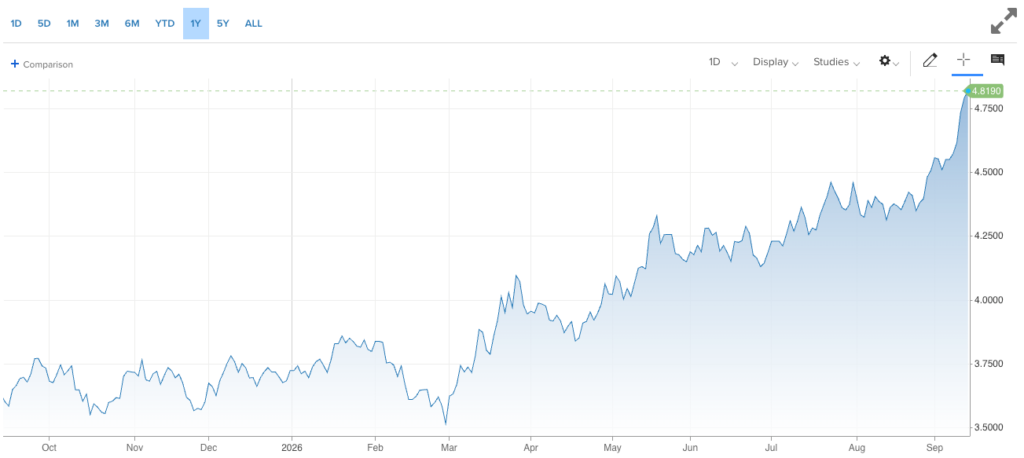
However, cap rates tend to lag big moves in interest rates by a year or more. When interest rates move, either sellers or buyers (depending on the direction of the move) tend to anchor to the old prices for a long time and transaction activity slows. Eventually, market participants come to terms with the new market environment and deal activity picks back up at different prices. Let’s say interest rates move up, as they have over the past few months, per the below chart. From a buyer’s perspective, the cost of financing has gone up considerably, while cap rates have not moved. This reduces the levered return, and makes the acquisition cap rates less attractive. Eventually, cap rates will move up, but there may be a pause in deal activity, especially for disciplined buyers that are not willing to stretch to meet the market.
We suspect that deal activity will slow, unless interest rates come back down quickly. If interest rates remain elevated, then cap rates will eventually adjust higher.
Closing Thoughts
After going through a real estate recession in 2022-2024, where a combination of interest rates and oversupply led to some sectors getting repriced by as much as 25%, we are finally coming out the other side of that. We believe we are at the start of the next real estate cycle, which is a good time to get involved in real estate. Expectations are low, prices are low, and rent growth is modest. Supply and demand are coming back into balance and occupancy is improving. Interest rates are worth keeping an eye on, since higher rates could eventually push cap rates higher. Though on balance, we like where things are headed.
Looking to learn more? Check out our various professional resources! Whether you have yet to break into the industry or are just starting out in a new role, we have everything you need. All you need to bring is your effort!
Thanks for reading!
Getting value from our free materials? Consider supporting us on Patreon 